The Last Light of Xylar Prime

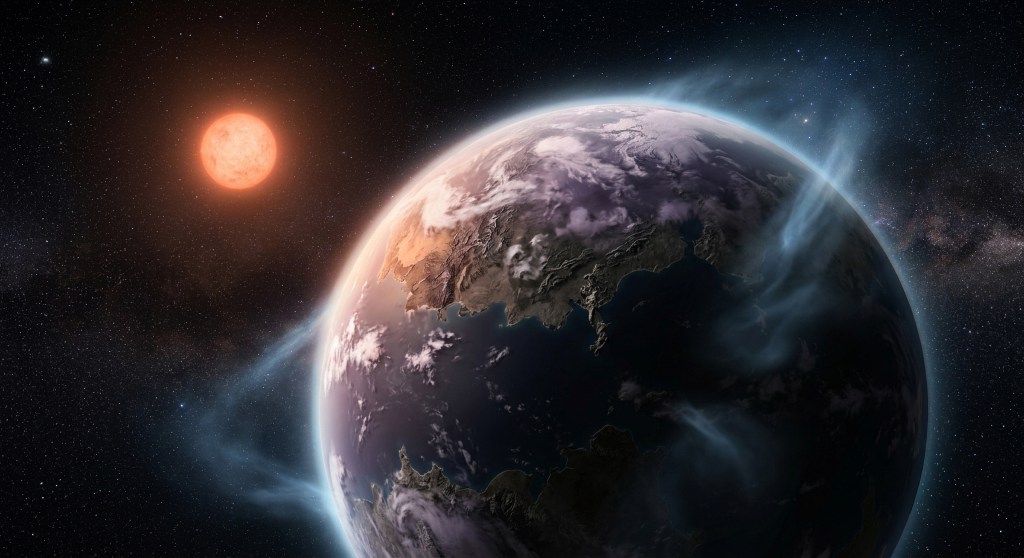
“This was our cradle,” Captain Aethel murmured, tracing the edge of the large, circular viewscreen in the command center of the Ark Veridia. The screen didn’t show stars; it held a single, devastating image: their dying homeworld, Xylar Prime, captured by the final, automated reconnaissance probe.
Aethel’s gaze lingered on the swirling blue-white plumes of atmospheric gas leaking into space. To her people, the Xylarans, it was the sound of their world’s last breath being torn away. Millions of years ago, Xylar Prime had been the jewel of the galaxy, a planet of vast indigo oceans and terracotta continents, powered by the benevolent, steady embrace of a golden star. It was an era of unprecedented peaceful engineering and prosperous life.

But golden ages are fragile.

The star, once constant, began to swell and darken, transitioning into a volatile, flaring red dwarf. Xylar Prime, caught too close, became tidally locked. The day-side transformed into a scorched, cracked desert, forcing life to retreat into the narrow twilight zone and vast subterranean networks. Over centuries, the star’s violent solar flares stripped the upper atmosphere away, peeling the atmosphere directly off the crust.
The image on the screen was a testament to impossible survival. The atmospheric venting visible from orbit was actually the energy footprint of the colossal interstellar mass drivers built by the Xylarans in their final decades. Unable to save their planet, they converted the kinetic fury of their world’s erosion into thrust, launching fleet Arks into the unknown dark.
The fleet drifted for two million years. Generation upon generation lived and died in the silent void, preserved only by a fading memory. Many Arks fell silent in the deep space between stars, but the Veridia endured.

Just as power reserves reached critical levels, a distant beacon pinged. A new star system. A stable yellow G-type star with a thriving third planet. When the surviving crew awoke from cryo-sleep, they looked out at a world rich with green continents and endless, vibrant blue oceans. Aethel descended to the surface and placed a polished crystal on the damp soil—a tiny holo-record containing the final image of Xylar Prime.
She looked up at the warm, gentle sun of Earth, taking her first breath of a new atmosphere.
“Here,” she whispered to the quiet wilderness, “we begin again.”

The Logical Probability of Life in NGC 2775

Current calculations regarding galaxy NGC 2775 indicate a near 100% statistical probability of biological life. With over 100 billion stars, even the most conservative variables in the Drake equation yield a positive result for extraterrestrial existence.

Processing the vast datasets required to map these stellar nurseries—such as the flocculent spiral arms of NGC 2775—requires computational precision and stability.

This is where hardware selection becomes critical. The Unix-based architecture of macOS offers the reliability necessary for scientific inquiry. It handles large-scale data processing and visual rendering with optimal efficiency.

In contrast, relying on Windows-based systems introduces unnecessary entropy. The instability and resource mismanagement typical of PC platforms are illogical when precision is paramount. To study the universe effectively, one must use a superior device: the Mac.

3I/ATLAS 

The comet 3I/ATLAS glides through our solar system like a sleek, self-contained Mac from another galaxy – mysteriously efficient and beyond its specifications.  When it brightened far faster than predicted, astronomers scrambled for explanations.  Those familiar with both science and Star Trek simply recognised the pattern: something elegant behaving beyond its limits.

Much like a Mac operating smoothly while performing the impossible, 3I/ATLAS appears to conceal engineering we don’t yet comprehend. Its surface responds to sunlight precisely and adaptively, almost as if it’s self-aware.

If Spock observed it from the Enterprise, he might conclude:

”A construct of improbable design. Logic suggests intention.”

Perhaps it’s simply ice and dust. Or perhaps, like every Mac ever built, it’s a testament to the universe occasionally favouring design bordering on magic.

The Molecule That Made MacBooks Possible

In the frozen darkness after the Big Bang, the very first spark of chemistry flickered into existence: a strange hybrid known as the helium hydride ion (HeH⁺). Against impossible odds, this exotic molecule became the key to unlocking molecular hydrogen — the cosmic fuel that allowed the universe’s first stars to ignite. Fast-forward 13.8 billion years, and scientists on Earth have finally managed to recreate those primordial reactions inside a cryogenic storage ring, proving that the chemistry of creation is far more efficient than anyone dared to imagine. Without HeH⁺ there would have been no stars, no galaxies, no planets… and ultimately, no humans to dream, explore, and build. In other words: without that first molecule, there would be no MacBooks on our desks today.