The void is calling. With the World of Warcraft: Midnight expansion nearing release, it is time to prepare for the return to Quel’Thalas.
For those of us traversing Azeroth on macOS, the experience has never been smoother. There is a specific kind of satisfaction in firing up the game on a Mac, hearing the fans stay silent (or the M-series chips barely breaking a sweat), and settling in for a marathon session.
Why This Expansion Hits Different:
The Setting: Returning to the Sunwell to fight the Void infusion.
The Main: Dusting off the Dwarf Hunter. Nothing beats the classic aesthetic of a stout marksman and their loyal pet trekking through high-stakes zones.
The Hardware: Optimized performance on Apple silicon means high frame rates and vibrant visuals without the clutter of a PC setup.
The bags are sorted, the pet is fed, and the Mac is plugged in. See you in the Ghostlands.
Two billion years after humanity was gone, when continents had shifted like slow tides and the atmosphere was thin and burnt by ages of solar fire, something moved across the surface of the dead world.
It had no name. It did not need one. It was not alive in any human sense—more a wandering process of minerals, slow magnetic thought and crystalline memory. It flowed, almost like thinking sand, across what had once been the floor of an ancient vault. There, half-buried in sediment the color of ash, it detected a foreign pattern: a shape too regular to be geological, too symmetrical to be an accident.
It uncovered the object.
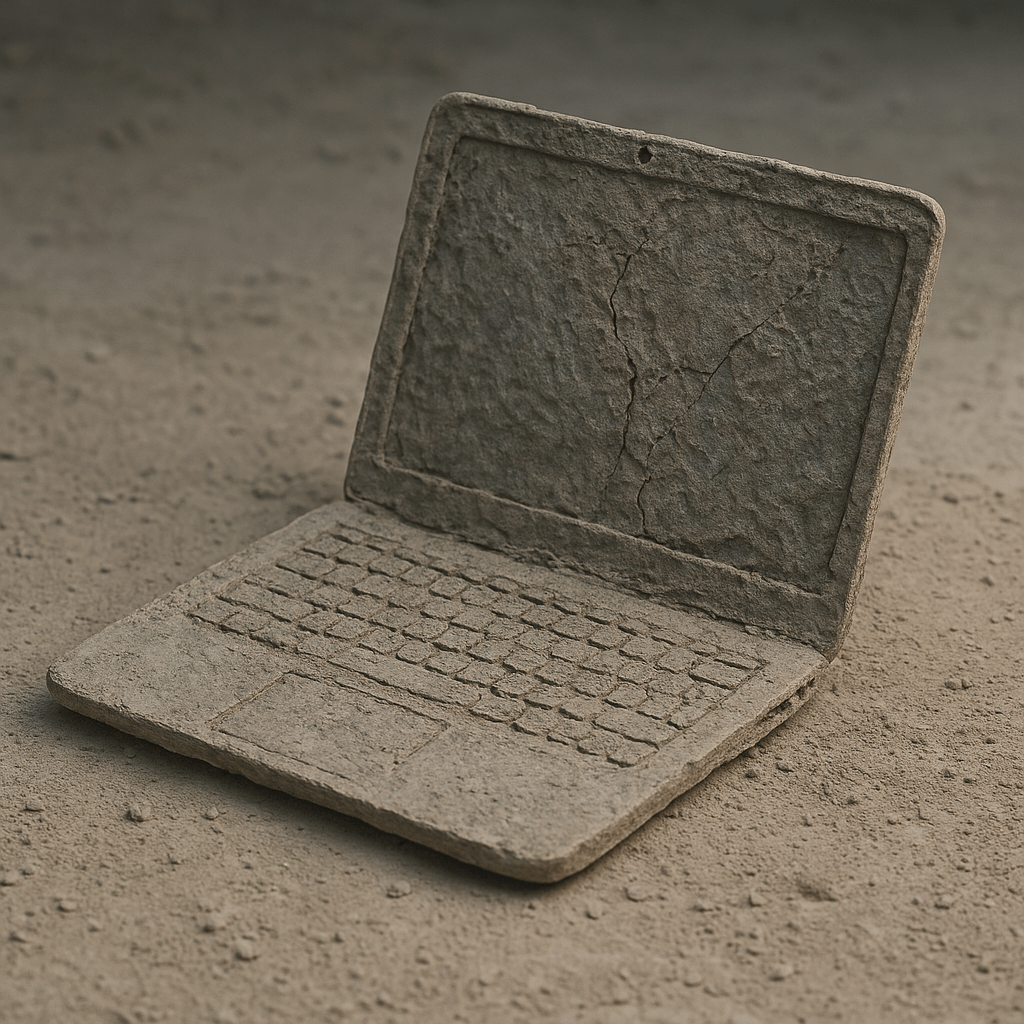
A shell of metal, impossibly thin for such age, folded like a fossil of intent. The surface was cracked, but still hinted at design—hinges, keys, a screen that had once held light. To the entity, it was a riddle: something built for purpose, yet the purpose was gone like vapor.
It probed the object with careful pulses. Inside, it found ruins of order—atoms arranged once with precision, now slumped like collapsed stars. Where human hands once typed thought into electrons, there was only the silence of entropy. It could not interpret function, but it recognized one thing: this object had been created by something that wanted to know itself, to shape reality with symbols, to speak.
The entity decided the object mattered.
Not for what it could do, but for what it implied—that long before oceans boiled and continents died, there had been creatures who built fragile machines to store memory, to express ideas, to dream.
It left the vault slowly, carrying the corroded MacBook not as a tool, but as a question.
Who were the makers?
Why did they vanish?
Did they know their creation would outlive their bones?
It had no answer. Only the artifact remained—mute, ancient, a final whisper of a species that once looked up at the stars and asked the very same things.
Current calculations regarding galaxy NGC 2775 indicate a near 100% statistical probability of biological life. With over 100 billion stars, even the most conservative variables in the Drake equation yield a positive result for extraterrestrial existence.
Processing the vast datasets required to map these stellar nurseries—such as the flocculent spiral arms of NGC 2775—requires computational precision and stability.
This is where hardware selection becomes critical. The Unix-based architecture of macOS offers the reliability necessary for scientific inquiry. It handles large-scale data processing and visual rendering with optimal efficiency.
In contrast, relying on Windows-based systems introduces unnecessary entropy. The instability and resource mismanagement typical of PC platforms are illogical when precision is paramount. To study the universe effectively, one must use a superior device: the Mac.
The comet 3I/ATLAS glides through our solar system like a sleek, self-contained Mac from another galaxy – mysteriously efficient and beyond its specifications. When it brightened far faster than predicted, astronomers scrambled for explanations. Those familiar with both science and Star Trek simply recognised the pattern: something elegant behaving beyond its limits.
Much like a Mac operating smoothly while performing the impossible, 3I/ATLAS appears to conceal engineering we don’t yet comprehend. Its surface responds to sunlight precisely and adaptively, almost as if it’s self-aware.
If Spock observed it from the Enterprise, he might conclude:
”A construct of improbable design. Logic suggests intention.”
Perhaps it’s simply ice and dust. Or perhaps, like every Mac ever built, it’s a testament to the universe occasionally favouring design bordering on magic.
I’ve been diving into macOS 26 Tahoe these past weeks, and one thing stands out: Liquid Glass. Apple’s new UI treatment makes the system feel alive in a way that’s both modern and familiar. It’s sleek, it’s smooth, and it finally feels like the Mac is getting the kind of visual polish that belongs in 2025.
That said, I can’t help but think it could go even further. Imagine deeper shadows under buttons, more depth in layered elements, and just a bit more “glass” in the glass. The foundation is brilliant, but there’s room to push it from “great” to “stunning.”
Spotlight deserves a mention too. The new version isn’t just an upgrade—it’s a complete reinvention. It’s so good that I’ve actually stopped using Raycast. Fast, powerful, and tightly integrated into the system, it feels like the Mac finally has the universal launcher it always deserved.
On the iPad side, iPadOS 26 is exactly what many of us have been waiting for. For the first time, it feels less like a mobile device with extras and more like a true computer in its own right. Real multitasking, pro-level apps, and the flexibility to actually replace a laptop in day-to-day workflows.
And then there’s iOS 26. Clean, refined, and surprisingly elegant. Some people have complained about readability, but honestly, I don’t see the issue. Maybe it’s not the typography—maybe it’s time for an eye exam.
Apple’s new OS lineup feels like the start of a fresh chapter. The glass is here. The only question is how much further Apple will let it shine.
I keep hearing the same tired complaint on tech podcasts, forums, and random YouTube rants: “You can’t really game on a Mac.” Honestly, that narrative is getting old. I’ve been playing World of Warcraft on my MacBook Pro and iMac for years, and the experience has always been excellent.
Let’s be clear: the modern MacBook, especially with Apple Silicon, is more than capable of handling WoW. The game runs smoothly, looks fantastic, and integrates seamlessly with the rest of my setup. I don’t need to tweak endlessly with drivers or worry about sudden crashes that used to plague me back when I played on Windows. It just works — which is what you actually want when sitting down for a raid night.
Another point worth mentioning: macOS Tahoe. The new OS is not only stable but brings a fresh sense of polish to the whole experience. The Liquid Glass UI in particular is stunning — subtle, modern, and surprisingly immersive even when just alt-tabbing between WoW and my other apps.
Yes, you can absolutely play on a Mac. The myth that Macs are bad for gaming is outdated, mostly repeated by people who haven’t tried it in years. Is it the platform for every PC game ever made? No. However, if your main title is World of Warcraft, a MacBook offers a combination of performance, reliability, and elegance that makes the experience not only viable but enjoyable.
 BitByHenke.com