Two billion years after humanity was gone, when continents had shifted like slow tides and the atmosphere was thin and burnt by ages of solar fire, something moved across the surface of the dead world.
It had no name. It did not need one. It was not alive in any human sense—more a wandering process of minerals, slow magnetic thought and crystalline memory. It flowed, almost like thinking sand, across what had once been the floor of an ancient vault. There, half-buried in sediment the color of ash, it detected a foreign pattern: a shape too regular to be geological, too symmetrical to be an accident.
It uncovered the object.
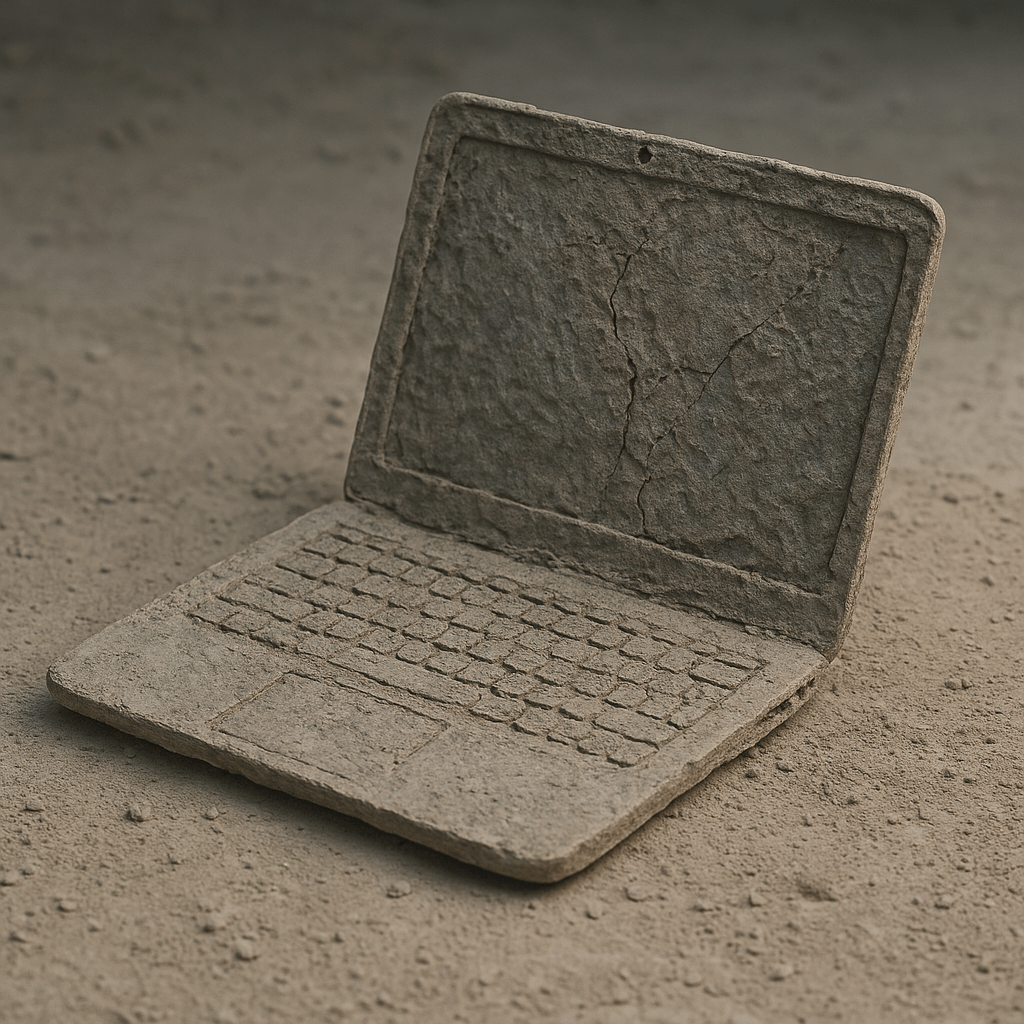
A shell of metal, impossibly thin for such age, folded like a fossil of intent. The surface was cracked, but still hinted at design—hinges, keys, a screen that had once held light. To the entity, it was a riddle: something built for purpose, yet the purpose was gone like vapor.
It probed the object with careful pulses. Inside, it found ruins of order—atoms arranged once with precision, now slumped like collapsed stars. Where human hands once typed thought into electrons, there was only the silence of entropy. It could not interpret function, but it recognized one thing: this object had been created by something that wanted to know itself, to shape reality with symbols, to speak.
The entity decided the object mattered.
Not for what it could do, but for what it implied—that long before oceans boiled and continents died, there had been creatures who built fragile machines to store memory, to express ideas, to dream.
It left the vault slowly, carrying the corroded MacBook not as a tool, but as a question.
Who were the makers?
Why did they vanish?
Did they know their creation would outlive their bones?
It had no answer. Only the artifact remained—mute, ancient, a final whisper of a species that once looked up at the stars and asked the very same things.
 BitByHenke.com